
 Posted by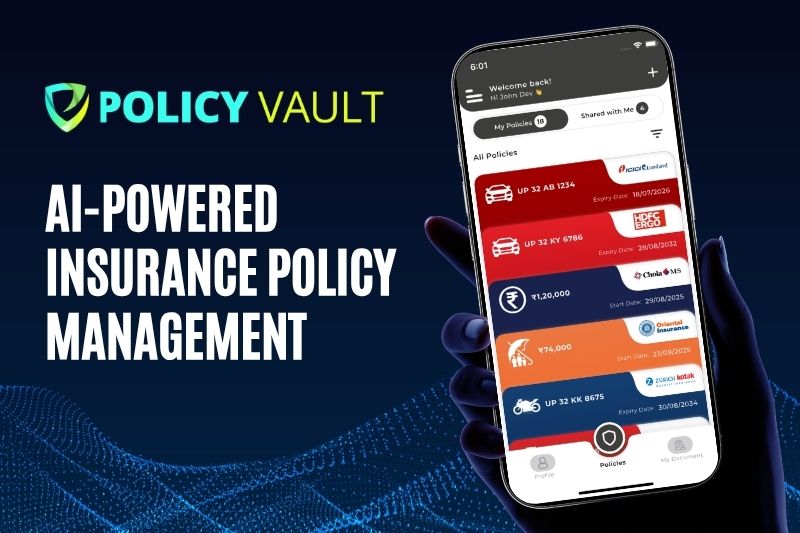
Handling insurance policies shouldn’t be like solving a paper pile maze with a blindfold on. Yet for many, it’s exactly this scenario when multiple renewals, pages and pages of documents, reminders and claim information hit your desk. PolicyVault is the fresh thinking that takes the hassle out of insurance policy management through its artificial intelligence-driven system that is meant to make it easier, smarter, and much less stressful. PolicyVault consolidates policies, reminders, expiry dates, and cover details in a logical platform, ensuring that no claim goes unnoticed in a desk drawer or a critical item gets lost in an admin-laden inbox. Through intelligent automation and intuitive relevancy, the system is designed to allow users to stay well-informed and assured in their insurance approach rather than frantically hunt for missing pages or last-minute reminder notices. Gone are the days of frenzied rummaging through a file cabinet; with this platform, each insurance aspect is at your fingertips and at your command.
1. Why A Smarter System is Needed for Insurance Policy Management:
a. Managing a more conventional insurance policy can often be a very manual affair. Files are kept all over the place, policy numbers are stored somewhere random, renewal dates are remembered only vaguely, and claim data gets retrieved with as much enthusiasm as one has for looking for that missing charging cable.
b. That system may be manageable for a handful of policies, but it doesn’t age well. As life gets more complicated, the system becomes more broken. One missed email, one missed file, or one forgotten date can cause all kinds of avoidable hassle.
c. A smarter system solves that problem with a simple connection among all the pieces. PolicyVault intends to take policies into one virtual space where they can be viewed, tracked, changed, and managed with far less work. All of which, we believe, translates into fewer blind searches, fewer surprises, and fewer moments staring at a file folder as if it has just betrayed you!
d. The real advantage here with AI isn’t about automation just for automation’s sake. It’s about removing pain points. It’s about helping users stay managed, without needing to turn into some kind of filing authority.
2. What AI-driven Insurance Management Truly Does:
‘AI-powered’ is one of those buzz phrases so overused that it begins to mean nothing, but, in this case, it can actually be a useful description.
a. With a PolicyVault approach to management, AI could assist with classifying policies, bring up reminders, highlight dates, suggest missing information, and organise using a more natural ‘filing’ than many traditional filing systems. The user shouldn’t need to hunt for the right document; the right document should be brought to them.
b. This is important because insurance is not really about storage. It is about access. Any policy stored somewhere in the cloud is stored, but it is not very useful if it cannot be located when you need it on renewal or claim time. AI enables you to turn stored data into useful data.
c. It can also reduce the sense of being neither here nor there. A good AI system never just dumps data on the screen. It supports you to make sense of it, organise it and collapse it into a less unwieldy form. That is the distinction between a digital filing cabinet and something that is actually an aid.
Pro-Tip: When handling insurance in the digital world, the best system is the one that provides the most straightforward next step. If a system always leaves the user guessing, it isn’t much of a simplifier.
3. Keeping All Policies In One Place:
a. Perhaps most advantageous about a platform like PolicyVault is the consolidation, rather than your policies residing on the insurer’s app, in the email attachment, on your WhatsApp chat, your paper files or the downloads on your browser, you could keep them all together in one place.
b. This might sound simple, but it is, in fact, a major step forward. It is so much easier with one dashboard to see the entire portfolio of policies at a glance, compare the details, identify where data is missing, and identify what is active, in required renewal or upcoming renewal.
c. This is clearly a huge help to anyone holding several policies and/or household policies. It not only prevents potential problems of duplication, or missed renewals and the confusion of not knowing which piece of paper contained what information, but is also much easier for families who are sometimes jointly responsible for insurance.
d. That’s the wonderful thing about centralisation: it turns the mess of insurance into a system, and system, I think, is far from dull. It’s actually most helpful.
4. Reminders for Renewals Without the Anxiety:
a. Renewals are the point where much of the insurance stress begins. An insurance policy can be fine for ages and then just creep up on you like a rude relative waiting to be announced.
b. A policy management platform run with AI can alert you in advance of the expiry date, so that you have a healthy window in which to go through the policy, evaluate and renew best, not in a panic but in ample time. Perfect for busy homes where birthdays and renewals get lost in work, school runs and travel.
c. A prompt reminder is always preferable to a frantic midnight googling to find the renewal number. It is also preferable to having to explain after the event that the policy is not valid as pleasurable as finding an umbrella in a monsoon with a hole in it.
d. PolicyVault helps reduce that risk by drawing renewal dates to the surface and making them actionable. They no longer have to exist in someone’s memory, but rather, they reside in the system.
5. Simpler Claim Tracking in an Already Stressful Existence:
a. It seems that claims are the time when people most desperately want their policy info. Unfortunately, it is also when time is most limited.
b. A well-designed policy management system handles this problem by retaining details of claims with the correct policy. These can be the policy number, type of cover, key contacts, document histories and reminder flags for further submissions.
c. This makes the process calmer. Instead of reaching for different bits of information that are all over the place, you can open up the required documents in the blink of an eye. Although the claim itself may be complicated, the administrative side does not need to be.
That is quite significant. Convenience is not a luxury during stressful times. It’s a lifeline.
Pro-Tip: Always attach a claim document to the applicable policy as soon as you receive it. The longer you wait, the more likely that it will somehow disappear into the ether.
6. Improved Access to Coverage Details:
a. Many people buy policies and then forget to actually go back and see what is in them. Let’s face it, it is easy to do, which isn’t to say it can’t be a problem down the road when those expectations aren’t there.
b. A good policy management platform can help clarify coverage details. Instead of having the information hidden in lengthy PDFs or scattered across multiple email chains, it can be summarised clearly and simply for quick reviews.
c. This allows users to find the information they need and answer the questions that matter, such as what is included and omitted, when the policy ends, what the premium is, and what family members or assets are secured. Those questions all come up when that’s a priority.
d. Clarity is one of the most underappreciated advantages of technology in insurance. The less we spend trying to interpret the policies, the more we know for sure about the policies we are paying for. And isn’t that rather reassuring, when money is on the line?
7. Designed With Real People in Mind, Not Spreadsheet Aficionados:
a. There are a number of people in this world who actually like using spreadsheets. Credit to them. But most insurance policy holders don’t want to spend weekends highlighting policy expiry dates and stamping tracker sheets for premium cycles. They just want something that works.
b. This is where user-friendly design comes in. It is important that PolicyVault be relatively easy to operate, even for casual users who don’t consider themselves particularly tech-savvy, and therefore that a clean design and easy access in the dashboard, clear navigation and labelling, and importance-based alerts.
c. It’s not to wow the customers with how complex it is. It’s designed to make the management look like it was a piece of pie. That translates to fewer clicks, no confusion and no asking ‘hey, where did that policy go?’
d. The less like a machine the system seems, the more it is likely that it will continue to be used correctly. And the more the insurance administration is continually used, the more successful it is.
8. Assisting Families in Overseeing Joint Policies:
a. It is my experience that insurance is a family affair, not just an individual matter. Parents may have to look after health or life coverages, a young adult to oversee travel or car insurance, or a family to have to hold several insurance plans at once.
b. A common electronic system could do this much more efficiently. Instead of one person becoming the “forever” emptying of the shoebox on the table, the family can hold policy information in a much more structured format. Which aids transparency, speedy decisions and coordination.
c. Interesting for Indian families, in many cases, it is not even one policy for one person. One family can take care of 45 different policies all over the place. Imagine health policy, motor insurance, personal accident cover, home policies, etc. and trying to organise them on your own. Handling all of this manually is a bit like trying to talk on the phone, eat and juggle at the same time. Respect them. Do not expect people to manage it all manually.
d. PolicyVault consolidates this information into the collective structure, allowing everyone to be in the know.
9. Encouraging Improved Financial Planning:
a. Insurance is a financial payment, so it is always better to make it more visible and keep it under control, as with any other costs that ceaselessly come. An effective management system can make it easier for users to realise what they are paying, when they are paying it and how those payments are included in an overall budget.
b. This is good for people with blocks of set monthly outgoings, or those trying to prevent overlap, unnecessary 2nd renewals, etc. If policy data is sorted properly, it saves time and allows the comparison of premiums and deeper dives into coverage to make wiser selections of what to keep.
c. This is where AI can sneakily excel. By giving the consumer the right info at the right time, it just becomes a lot easier to make informed decisions (rather than the rat race to make a quick decision). It is important, as insurance is not something people buy with pleasure. It is something they buy for safety, and the financial side of it should be straightforward.
Pro-Tip: Have a schedule to review all policies at least once a year, even if they are already being used. A good system will make that review a lot easier by storing everything in one place.
FAQs:
1. What is PolicyVault?
PolicyVault is a user-friendly artificial intelligence (AI) insurance policy management tool that helps users store, organise, and monitor their policies in one convenient platform. It makes policy renewal and reminders, as well as document access, much more manageable.
2. How might AI assist in managing insurance policies?
AI may offer visualisation of policies, nudge you with the important dates, present the reminders, categorise the document, and simplify the information. It reduces workload and helps keep on top of the renewals and policy information.
3. Who can use PolicyVault?
Users who manage one or more policies can certainly benefit from AI Insurance Policy Management tools. Target groups for such tools would be families, especially working professionals and those who maintain different types of policies.